What Mac System Data means—and what a file scan cannot explain
Treat System Data as a broad storage category, then separate observed files, access gaps, APFS snapshots, file-system overhead, and excluded boundaries.
Direct answer
System Data is not one folder that a cleaner can safely remove. It is a broad macOS storage category whose total can reflect caches, logs, temporary data, application support, local snapshots, file-system behavior, and data that a third-party scan cannot read or attribute. Investigate exact paths and coverage instead of deleting the category.
When this guide applies
- System Settings shows a large or changing System Data category.
- A startup-disk scan accounts for less allocated file data than the volume reports as physically used.
- You need to separate specific reviewable paths from snapshots, overhead, exclusions, and permission gaps.
Step-by-step review
Record the macOS category and volume totals
Capture the current System Data label, used space, and available space as a time-specific observation rather than a permanent fact.
Scan one explicit boundary
Use the accessible startup disk or a selected folder and keep unreadable paths and excluded roots visible.
Separate observed files from the remainder
Compare physical used space with observed allocated files; keep the difference labeled as unaccounted, not reclaimable.
Inspect specific paths and owning workflows
Review caches, developer data, downloads, application support, backups, and provider-managed storage by exact path and owner.
Use Apple tools for system-owned evidence
Review APFS snapshots in Disk Utility and storage recommendations in System Settings rather than attempting to remove hidden system structures manually.
How macOS works here
A category label is not path ownership
macOS can group data for presentation differently from a path-level scanner. The same underlying bytes may be described through different concepts.
The accounting remainder has several possible sources
APFS snapshots, file-system metadata, auxiliary volumes, compression, clones, unreadable locations, and excluded boundaries can all contribute.
Reviewable paths still need owning-app context
A cache or support directory may be visible and large, but the responsible application or Apple workflow should define its safe management route.
A safer way to break down System Data
| Evidence group | What can be observed | Safe conclusion |
|---|---|---|
| Observed files | Exact paths, types, timestamps, logical size, and allocated size within the readable scope. | Review by owner and recovery route; size alone is not permission to remove. |
| Access gaps | Unreadable counts and representative protected paths. | Missing evidence must remain visible; it is not an empty folder. |
| Excluded boundaries | External, network, duplicate support mounts, devices, and other roots outside the scan contract. | Do not merge their totals into the selected startup-disk scope. |
| Snapshots and overhead | Volume-level usage and Apple-visible APFS snapshots, but not every byte as one path. | Use system tools and treat the remainder as accounting evidence, not cleanup inventory. |
Risks and actions to avoid
Do not remove hidden system paths manually
SIP, Data Vaults, volume-group structure, and system-managed files exist outside a generic cleanup rule.
Full Disk Access does not make every byte explainable
It can remove some TCC restrictions but does not bypass Unix permissions, SIP, private Data Vaults, or file-system accounting limits.
System Data changes over time
Caches, local snapshots, updates, indexing, and application activity can change the category after any single observation.
What the Omuuz product can—and cannot—do
What it can do
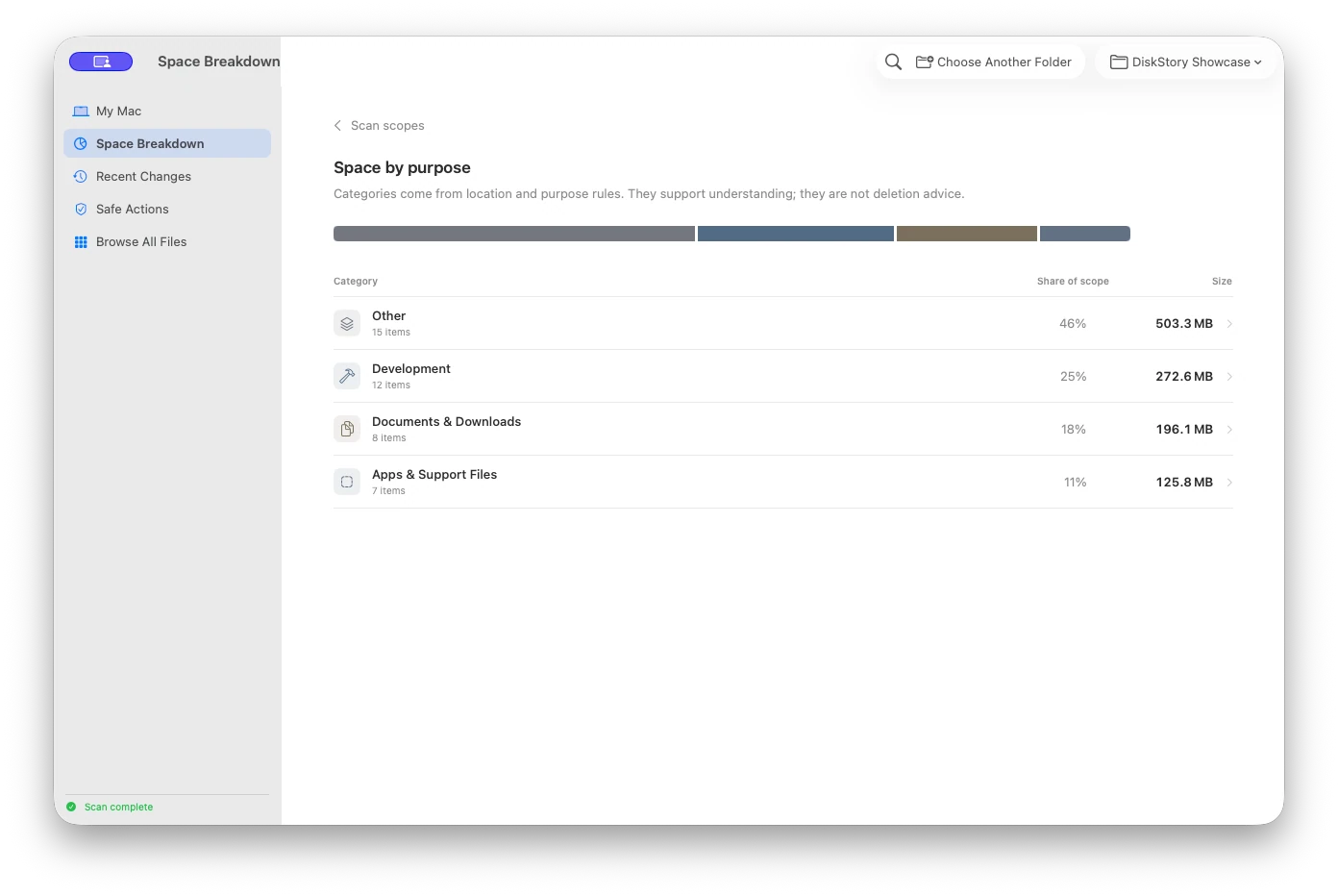
DiskStory can map readable allocated files, preserve scan coverage, show unreadable and excluded boundaries, and separate observed files from the remaining physical-usage difference.
What it cannot do
DiskStory cannot reproduce Apple’s private category calculation, inspect every protected byte, delete System Data as one object, or guarantee that the accounting remainder is reclaimable.
Product evidence